
Summary
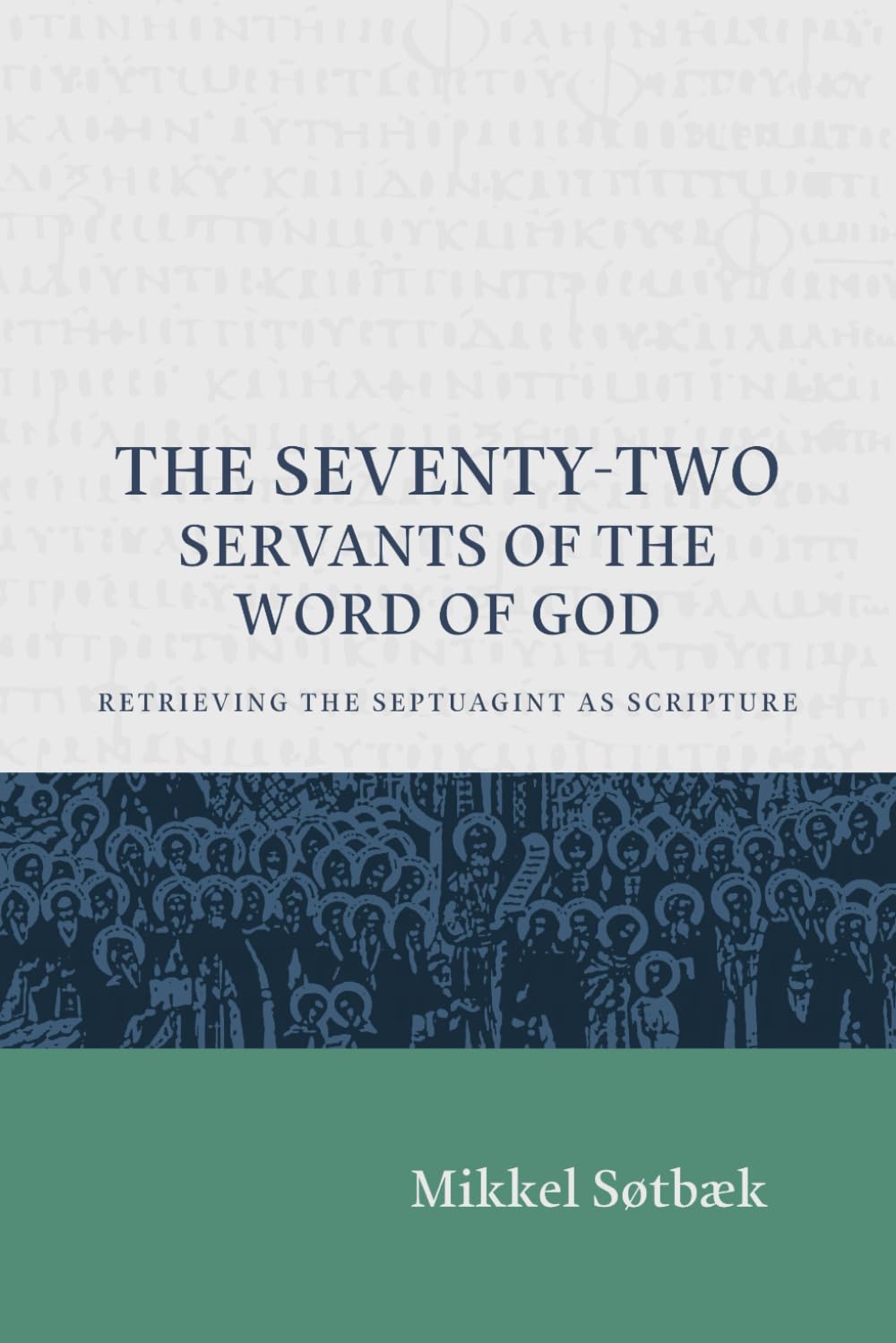
Mikkel “Michael Potamopotos” Søtbæk (a Danish Confessional Lutheran) provides an easily-digestible case for favoring the Septuagint (LXX) as the authoritative text type of the Old Testament. Despite some unfortunate formatting and typographical errors in this first printed edition of Mikkel’s monograph, the substance of his arguments are rock solid, and though one may be able to nitpick a few of his points, their cumulative force prove unassailable.
This is not a comprehensive case for the Septuagint, but it is certainly a sufficient case, and it the strongest case yet compiled in written form. For those unfamiliar with the LXX, it serves as an excellent starting point; even for those with existing knowledge (such as myself), it is an excellent overview and summary to refer back to, covering much ground in little space. I highly recommend this book to everyone interested in studying Scripture.
Background and presentation
This book has been a long time coming, and I’ve been waiting for it since I was first recommended the recordings of a two-part discussion on The Other Paul’s YouTube channel, in which Mr. Søtbæk discussed some of the content of the book. These streams serve as a decent, albeit long and less organized preview of the book, if you’re curious:
Since the release of these streams in 2022, it has taken an additional three-and-a-half years for the book to reach publication. In mid-2025, he gave a briefer, audio-only overview on The Gottesdienst Crowd podcast. But this December, the book was finally released, and I am pleased to report it was worth the wait.
Printed in its first edition as a paperback, this book is rendered with a comfortable text size, reasonable margins (large enough to scribble some short notes), and a generally well-organized structure with chapters, sub-sections, a list of tables and figures, and plenty of footnotes throughout.
Like the Septuagint, this book is a translation: Mr. Søtbæk had originally written his monograph as his master’s thesis and in his native language of Danish1, and he has now translated it both in language and in form into an English book. Unlike the Septuagint, however, this book is an imperfect translation.
Though the English is overall well-written, there are nevertheless a few instances of awkward and confusing phrasing that seem to betray that certain statements were not originally composed in English. The text could do with some more em dashes, semicolons, and parentheses to more clearly delineate clauses. I spotted a few spelling typos, accidental grammatical inversions, and missing words throughout, which I expected.
Less expected, however, were the formatting errors. Unfortunately, it seems the book has also suffered somewhat in its translation from digital thesis to monochrome paperback.
Starting off with something harmless and subtle: the title page inside the book and every page heading gives the title as “Seventy-Two Servants of the Word”, whereas the external cover and the copyright page render the slightly more verbose “The Seventy-Two Servants of the Word of God”, which is an understandable change for marketing purposes. One might even suppose that the inclusion of the alternative title is intended.
Less subtle and certainly not intended, however, are certain places where the text of the book references a figure “above”, which is actually on the next page, or mentions comparing something on the left to something on the right, when the actual order is reversed. Evidently certain illustrations were shuffled around during the editing process, and the text was not updated accordingly.
The most egregious example is on pages 65–66, where the text directs the reader to notice certain phrases in a chart that are supposedly highlighted in yellow and turquoise. This useful and colorful formatting may be glimpsed in the digital form of the document referenced in one of the 2022 livestreams hosted by The Other Paul, but the book’s current format makes such highlighting impossible, and no substitute has been provided.
These mistakes are distracting and far more common than I would like, but thankfully, they are all merely surface level. The actual meat of the content is unaffected, and though I have some minor complaints about that as well, they are (despite the length of words I am about to dedicate to them) mere nitpicks in comparison. Perhaps some small good will even come of these slight errors, in that they may serve as traps at which midwit critics of the book will attempt to tear down the impenetrable castle2 which Mr. Søtbæk has constructed, and thereby demonstrate their own folly. (But I’d rather that such people just not be stupid.)
The content
My favorite parts
The section on Church father support for the Septuagint is more extensive than I had expected, and this is one of the most useful aspects of the book; for although comparisons of Old Testament quotations in the New are relatively easy to compile in this digital age, Church father quotations are much harder to find and sort through. Though I walked into this book already convinced that the Church fathers held the Septuagint as authoritative, the witness provided in this book was even stronger than I knew, for there are many references here I was not yet aware of.
I was pleasantly surprised to discover that Part IV (especially, but also indeed the entire book) not only addresses but utterly annihilates one of the most annoying “arguments” (to give too much credit to its proponents) I’ve ever encountered against the Septuagint—namely the claim that there is no single translation to which the title “Septuagint” can be applied.
Multiple volumes could be filled with books listing the differences between the Septuagint and Masoretic Text and the resulting implications that flow from each difference. I myself have spent a great deal of time investigating such differences of varying significance, and I am thus well aware of how bountiful the harvest is. It is therefore quite important for a summary work such as this to carefully pick which examples it spends its pages on. I am therefore pleased to report that this book has generally chosen a very strong set of examples, such that one could construct a strong case for the Septuagint on these alone, even without the rest of the arguments made within and without.
To speak much more on what the book gets right might risk simply repeating what is already stated therein, so I shall now move onto my critiques of the content, which although long, may be addressed with very short alterations.
My nitpicks
Languages of the Babatha letters
On page 17, it would’ve been nice if the languages of the remaining Babatha Letters were briefly mentioned. On first read, one might assume the remainder are written in Hebrew, but a quick search online suggests their language to instead be Nabatean-Aramaic and Jewish-Aramaic3. Briefly mentioning this would strengthen the argument being made.
Ezra 4:18 and the translated letter to Artaxerxes
In the section titled “From King Josiah to Ezra”, on page 18, a claim is made that a particular word (H6567) in Nehemiah 8:8 can and should be understood as meaning “translated” in the given context, by demonstrating that a closely-related word (H6568) is used in such a way in Ezra 4:18. I find this argument a bit weak—perhaps the weakest argument in the entire book.
Now, certainly, both Masoretic Ezra and Greek Esdras B say the letter was translated in an earlier verse, though Esdras A entirely omits this detail:
| Masoretic Ezra 4:7 (ESV) | In the days of Artaxerxes, Bishlam and Mithredath and Tabeel and the rest of their associates wrote to Artaxerxes king of Persia. The letter was written in Aramaic and translated. |
| Esdras B 4:7 (NETS) | And in the days of Arthasastha, they wrote in peace—Mithridates, Tabeel with also the rest of his fellow-slaves—to Arthasastha, king of the Persians; the tribute collector wrote in Syrian a document, also having been translated. |
| Esdras A 2:15 (NETS) | Now in the times under Artaxerxes, the king of the Persians, Beslemos and Mithridates and Tabellios and Raoumos and Beelteemos and Samsaios the scribe and the rest of those associated with them but living in Samaria and the other places wrote out the following letter to him against those who were living in Judea and Ierousalem, |
Note that the Masoretic Hebrew word rendered as “translated” here is H8638, from which we get the word “targum”. The Greek word here in Esdras B is ἡρμηνευμένην (G2059), from which we get “hermeneutics”. Both can quite clearly be understood as meaning “translated” here.
I would interpret this passage as saying that two versions of the letter were prepared: one in Syrian (Aramaic), and another in (presumably) Persian.
Note, however, that the word used in the Masoretic Text here is not the one found in Masoretic Ezra 4:18, and in fact the Greek versions of the latter passage make no mention whatsoever of the letter being translated in the king’s presence:
| Masoretic Ezra 4:18 | the letter that you sent to us has been translated/made-clear before me… |
| Esdras B 4:18 (NETS) | the tribute collector whom you sent to us was summoned before me… |
| Esdras A 2:22 (NETS) | I read the letter that you have sent to me… |
The level of divergence between Masoretic Ezra and Esdras A is somewhat expected, but the level of divergence between Masoretic Ezra and Esdras B is surprising, and (certainly if one takes a Septuagint primacy view) suggests that the Masoretic Text is corrupt and perhaps even incoherent here, which would hamper its utility in determining the meaning of H6567 & H6568.
Furthermore, the preceding passage in 4:7 (of both Masoretic Ezra and Esdras B) already seems to imply that the letter was translated before being delivered to the king, which would make it odd for the king to then reply as if the letter had been translated after reception. Thus, a reading of “made clear” (with the resulting sense that the king was simply confirming that the already-translated version of the letter had been understood clearly by him) would seem to be a more coherent reading of the Masoretic Ezra.
On the other hand, if the word used in the Masoretic Ezra 4:18 is indeed best understood as “translated”, then any resulting incoherence would favor the accuracy of the LXX in this passage against the Masoretic Text. But while that would serve the goals of the book, it is not the argument made on the page.
Ultimately, I think the other evidence presented in the book for the increasing loss of Hebrew and adoption of Aramaic is sufficient for the overall points being conveyed, and that the appeal to Ezra 4:18 is perhaps a bit too shaky to be worth inclusion.
Note on scholarly notation
On page 28 I noticed “(Acts 10:24f)” and “(verse 44f)”, which confused me at first since the “f”s looked to me like either verse-subdivision indicators or indicators of additional verses not present in all manuscripts (and thus outside the common verse numbering scheme); but after looking it up, I now understand that this is merely a standard shorthand for saying “and the next verse”. I wonder if perhaps this use of scholarly notation (unexplained in the book itself) is unsuited to its intended audience. But it is a very minor thing.
The name of the translator of the Wisdom of Jesus the son of Sirach
I was initially rather confused by the wording on page 43, since it gave the name of the man who translated the Book of Sirach into Greek as “Jeshua ben Sirach” and “Joshua, the son of Sirach”. First of all, there’s a bit of inconsistency between the section heading and the text under it, but far more confusing is that this name is applied to the translator.
Now, Jesus (Joshua) is the name of the guy who first wrote the book, and 50:27 says Jesus’ father was named Sirach, but the grandson translator never names himself.
Another prologue (historically attributed to Athanasius but now deemed of later origin) gives the translator’s name as Jesus and his father’s name as Sirach, thus making the translator’s name identical to the original author, and producing a lineage that looks like Sirach → Jesus → Sirach → Jesus (unless 50:27 is instead viewed as the signature of the translator, which seems unlikely to me). Even if this prologue is correct, I think it would be much clearer if the book simply called the translator “the grandson of Jesus son of Sirach”.
Philo and his audience’s native tongue
In section “The Jewish Reception of the Septuagint”, on page 45, my initial read led me to think that the author was claiming that many Hebrews contemporaneous to Philo had Greek as their native tongue, on the basis of these words of his:
but in our own [language] it means “turning oneself away from God”
I had assumed that “our” referred to the Hebrews in general. However, upon closer inspection, a fuller version of the quote suggests something slightly different—namely that the Hebrews said “Phanuel” (notably the same transliteration of the name used in LXX Judges 8), whereas Philo and his audience natively spoke Greek.
Ἔστι δὲ ὡς μὲν ᾿Εβραῖοι λέγουσι “Φανουὴλ”, ὡς δὲ ἡμεῖς, ἀποστροφὴ θεοῦ.
“On the Confusion of Tongues” by Philo of Alexandria, chapter 26
It is, as the Hebrews say, “Phanuel”, but as we [say], “turning away of God.”
Literal English translation of Philo quote
On second read, I now realize that this section of the book was simply making a point that Greek had made inroads into the elite levels of the Hebrew society. Still, I suspect my initial confusion could be repeated by others, so I think including the full quote might clarify the point being made.
The opening of eyes in Isaiah
In section “The Use of the Septuagint by Christ”, on pages 65–67, one of the most powerful arguments in favor of the Septuagint is put forth: Christ’s reading of the Book of Isaiah in the Nazareth synaogogue. To reiterate the comparison given between the Greek of Isaiah and the Greek of Luke (now in living color):
πνεῦμα κυρίου ἐπ’ ἐμέ οὗ εἵνεκεν ἔχρισέν με εὐαγγελίσασθαι πτωχοῖς ἀπέσταλκέν με ἰάσασθαι τοὺς συντετριμμένους τῇ καρδίᾳ κηρύξαι αἰχμαλώτοις ἄφεσιν καὶ τυφλοῖς ἀνάβλεψιν καλέσαι ἐνιαυτὸν κυρίου δεκτὸν […]
Isaiah 61:1–2 (Rahlfs’ LXX)
[…] ἀπόστελλε* τεθραυσμένους ἐν ἀφέσει […]
*imperative form
Isaiah 58:6 (Rahlfs’ LXX)
πνεῦμα κυρίου ἐπ’ ἐμέ οὗ εἵνεκεν ἔχρισέν με εὐαγγελίσασθαι πτωχοῖς ἀπέσταλκέν με [ἰάσασθαι τοὺς συντετριμμένους τὴν* καρδίαν*] κηρῦξαι αἰχμαλώτοις ἄφεσιν καὶ τυφλοῖς ἀνάβλεψιν ἀποστεῖλαι** τεθραυσμένους ἐν ἀφέσει κηρῦξαι ἐνιαυτὸν κυρίου δεκτόν
*these two words are in accusative case (as opposed to the dative case used in Isaiah), but this has no effect on the meaning
Luke 4:18–19 (Greek; bracketed section is absent in Alexandrian & Western Texts, but present in Byzantine Text and Irenaeus’ Against Heresies)
**infinitive form
And now in English, with the Masoretic Isaiah added to the comparison, and certain rendering choices adjusted (relative to Mr. Søtbæk’s book) to provide a more precise comparison…
the Spirit of the Lord is upon me, because of which he has anointed me to bring good news to the poor, he has sent me to heal the brokenhearted, to proclaim to the captives liberty* and to the blind a recovery of sight**, to call*** the acceptable year of the Lord […]
*can also mean “pardon/forgiveness”
Isaiah 61:1–2 (Rahlfs’ LXX → English)
**etymologically “a looking up”
***can also mean “to proclaim”
[…] send out the oppressed in release […]
Isaiah 58:6 (Rahlfs’ LXX → English)
the Spirit of the Lord is upon me, because of which he has anointed me to bring good news to the poor, he has sent me [to heal the brokenhearted,] to proclaim to the captives liberty* and to the blind a recovery of sight**, to send out the oppressed in release, to proclaim the acceptable year of the Lord
*can also mean “pardon/forgiveness”
Luke 4:18–19 (English; bracketed section is absent in Alexandrian & Western Texts, but present in Byzantine Text and Irenaeus’ Against Heresies)
**etymologically “a looking up”
the Spirit of the Lord LORD is upon me, because the LORD has anointed me to bring good news to the poor, he has sent me to bind* the brokenhearted, to proclaim to the captives liberty and to the imprisoned an opening, to call** the acceptable year of the Lord […]
*i.e. “bandage”
Isaiah 61:1–2 (Masoretic Text → English)
**can also mean “to proclaim”
[…] send out the oppressed free […]
Isaiah 58:6 (Masoretic Text → English)
This is an exceptionally powerful argument, but there is one unspoken detail that, although not ultimately harmful to the argument, I nevertheless wish had at least been mentioned for the sake of preempting and shutting up the ignorant who might otherwise claim it as a “gotcha”: there is technically another passage in Isaiah which speaks of God’s Servant giving sight to the blind, which also bears some resemblance to the passage in Luke.
ἀνοῖξαι ὀφθαλμοὺς τυφλῶν ἐξαγαγεῖν ἐκ δεσμῶν δεδεμένους καὶ ἐξ οἴκου φυλακῆς καθημένους ἐν σκότει
Isaiah 42:7 (Rahlfs’ LXX)
To open eyes of the blind, to lead out of bonds the bound, and out of the house of prison those sitting in darkness.
Isaiah 42:7 (Rahlfs’ LXX → English)
To open blind eyes, to bring out of dungeon the bound, from the house of prison those sitting in darkness.
Isaiah 42:7 (Masoretic Text → English)
Some might contend that Christ is referencing Isaiah 42:7 and synthesizing it with Isaiah 61:1–2, in a similar way to how Isaiah 58:6 has been incorporated, and that therefore, it cannot be certainly claimed that Christ is referencing anything specific to the Septuagint. This objection, however, does not hold up well under scrutiny.
Although there is obviously an overlap in meaning (contextually, the passage speaks of God’s Servant making blind men see and leading men out of prison), the actual words are quite different. For example, the Greek term used in LXX Isaiah 61:1 and Luke 4:18 rendered as “recovery of sight” is ἀνάβλεψιν; etymologically, this term could woodenly be rendered as “a looking up“. This is different from the phrasing of “to open eyes” (ἀνοῖξαι ὀφθαλμοὺς) that is used in Isaiah 42:7 as well as in the New Testament (e.g. John 10:21 & Acts 26:18).
Now, the “looking up” terminology does appear in LXX Isaiah 42:18, but the context and tone are rather different (God is chastising the Israelites for their idolatry, calling them spiritually blind and deaf), and the form of the words are still not as close to Luke 4:18 as LXX Isaiah 61:1 is. Somewhat ironically, the Masoretic Hebrew of this verse is less similar than the Greek, since only the Greek specifically conveys the sense of looking up.
οἱ κωφοί ἀκούσατε καὶ οἱ τυφλοί ἀναβλέψατε ἰδεῖν
Isaiah 42:18 (Rahlfs’ LXX)
O deaf, hear, and O blind, recover sight* to perceive!
Isaiah 42:18 (Rahlfs’ LXX → English)
*etymologically “look up”
O deaf, hear, and O blind, look to see!
Isaiah 42:18 (Masoretic Text → English)
Had Christ intended to specifically reference Isaiah 42:7 (the most similar passage in terms of meaning that appears in the Masoretic Text), He could have used the same terminology of opening eyes (ἀνοῖξαι ὀφθαλμοὺς) that already occurs both in the Greek of Isaiah 42:7 as well as in the New Testament (e.g. John 10:21 & Acts 26:18). That the exact words of LXX Isaiah 61:1 are used instead is clearly an endorsement of its particular reading over that of the Masoretic Text.
Furthermore, I must reiterate that Luke describes Christ as reading from a written copy of the Book of Isaiah, so such a loose paraphrase would be quite inappropriate (and entirely unnecessary, since Isaiah has no shortage of relevant passages that could’ve been quoted here). I’d further posit that the slight deviations from our now-common LXX that occur in Christ’s reading may have been actual variants in the manuscript Christ was reading from, and that He (knowing they made no real difference to the meaning of the prophecy) simply read the text exactly as written.
Finally, to “answer a fool according to his folly” (Proverbs 26:5): consider that Luke specifically says “the scroll of the prophet Isaiah was given to him. He unrolled the scroll and found the place [singular] where it was written”. The words of Isaiah 58:6 and Isaiah 61:1–2 are not incredibly distant from each other, but Isaiah 42:7 is quite far indeed from both. Are we to assume that “place” in the scroll covered the entirety of 42:7 to 61:2?
The simple, reasonable conclusion is that Christ was indeed reading and quoting from the Septuagint.
(Blind ones seeing is also mentioned in Isaiah 29:18, Isaiah 35:5, and Isaiah 42:16, but those are all even more dissimilar to the passage in Luke, and most of the previously-given points still apply.)
Thoughts on Theodotion
Throughout the book, the name “Theodotian” is used, but the standard form derived from the Greek and appearing in most places online is “Theodotion”. I don’t know why a non-standard spelling is being used here. Is this how they spell it in Denmark?
Relatedly, I think it might’ve been worth mentioning in the “Theodotian and Daniel” section (pages 147–149) that Irenaeus, who in Against Heresies Book III Chapter XXI attacks Theodotion and the other Jewish translators, also seemingly quotes the so-called Theodotion Daniel thrice in Book IV Chapter XXVI of the same work.4 This seems to be much stronger evidence for the “Theodotion” text predating Theodotion than the supposed (and very tenuous) New Testament references to it that were given. Perhaps Mikkel was not aware of this detail?
Digression on the origin of the two Greek versions of Daniel
I have a hypothesis that the version of Daniel attributed to Theodotion may not only predate Theodotion, but might even be the official LXX version, while the “Old Greek” version is descended from the partial, unofficial translations Aristobulos was aware of (as mentioned on page 43), perhaps being later expanded to include sections first translated by the LXX project (possibly explaining why some sections of the two versions resemble each other more than others).
Speculating a bit further, I’d posit that Origen was unaware that such a pre-LXX text was circulating, and that he may thus have mistakenly assumed that the version more closely resembling the proto-Masoretic Text was the work of Theodotion, while the other was the Septuagint. It could also be the case that Theodotion never produced a revision of Daniel at all and simply “reposted” a preexisting version that was later attributed to him as a result; or perhaps he did produce a revision based on this preexisting version, but his changes were so minor that the two were easily confused for each other.
Notably, the so-called Theodotion version, although generally closer to the Masoretic Text than the so-called Old Greek, nevertheless sometimes diverges from the Masoretic—even in a few places where the Old Greek does not:
| chapter/verse | “Old Greek” | Masoretic | “Theodotion” |
|---|---|---|---|
| 9:24 | decreed | decreed | cut short |
| 9:24 | to anoint | to anoint | to gladden |
| 9:25 | build Jerusalem a city for the Lord | build Jerusalem until an anointed leader | build Jerusalem until an anointed leader |
| 9:26 | shall be torn away and will not be | shall be cut off and have nought | shall be destroyed, and there is no judgement in him/it |
Although it is not entirely clear on this point, the wording of Origen’s Letter to Africanus seems to suggest that the so-called Theodotion version was already circulating within the churches:
For in Daniel itself I found the word “bound” followed in our versions by very many verses which are not in the Hebrew at all, beginning (according to one of the copies which circulate in the Churches) thus: “Ananias, and Azarias, and Misael prayed and sang unto God,” down to “O, all ye that worship the Lord, bless ye the God of gods. Praise Him, and say that His mercy endureth for ever and ever. And it came to pass, when the king heard them singing, and saw them that they were alive.” Or, as in another copy, from “And they walked in the midst of the fire, praising God and blessing the Lord,” down to “O, all ye that worship the Lord, bless ye the God of gods. Praise Him, and say that His mercy endureth to all generations.” […] Of the copies in my possession whose readings I gave, one follows the Seventy, and the other Theodotion […]
Origen’s Letter to Africanus (c. 203-240 AD)
It would be quite surprising for a Theodotion-produced version to be circulating in the churches at this time (and to then become so popular that the supposed Septuagint version nearly vanished), considering the contemporary attitudes toward the Septuagint; but it would be much less surprising if the version in fact predated Theodotion and perhaps even is the true Septuagint version.
There may be something I’m missing. Still, as the book says, this is a “fruitful field for further research”, and the matter awaits an answer from the mouths of faithful men.
Where is the Peshitta?
Something left entirely unmentioned in the book (and never even alluded to except indirectly through a brief mention of “Syriac-speaking Christians” on page 109) is the Peshitta: a translation of the Bible commonly believed to have had its Old Testament completed during or before the 2nd century AD, which bears much resemblance to a proto-Masoretic Text5.
This version would seem to be the sole exception to the Septuagint rule over the realm of early translations that circulated in the Church. Apparently it was held in high regard in the Syriac Christian tradition, and it is still used to this day in the Syriac churches—somewhat similar to how the Septuagint is still used by the Greek-speaking churches.
A cursory search online brought up “The Syriac Versions of the Old Testament” by Bas ter Haar Romeny, and a quick read through that led me to this relevant paragraph:
The earliest reference to the origins of the Peshitta is found in Theodore of Mopsuestia’s commentary on the Twelve Prophets. This Greek-speaking exegete (d. 428) says that the Syriac Bible was composed by some unknown man who often made mistakes, and even made up stories. Therefore, he argues, this Syriac Bible could by no means compete with the Septuagint6. Theodore was reacting against Eusebius of Emesa (see § 3 above), an earlier representative of the Antiochene School of exegesis, to which Theodore also belonged. Eusebius had defended the importance of the Hebrew text as the original version of the Old Testament, and had used informants and the Peshitta to get access to it. Eusebius knew that Syriac (his mother tongue) and Hebrew were ‘neighbours’. For this reason, he had accorded the Peshitta a special status. For Theodore, however, the most reliable way to access the Hebrew was via the Septuagint. He endorsed the view that the Septuagint was a translation made by seventy very learned persons who had independently come to the same renderings, and that it was, furthermore, adopted by the Apostles, who handed it down to the Gentiles. Theodore was anxious not to add anything to the biblical text. He was afraid of speculation. The fact that it was unknown to him who had translated the Peshitta, made him shun the latter version.
“The Syriac Versions of the Old Testament” by Bas ter Haar Romeny (2005)
The article then proceeds to discuss various later accounts and modern hypotheses attempting to explain the origin of the Peshitta, leaning towards a Hebrew origin, though whether these hypothetical Hebrews were Jews or Christians is unclear. It also discusses three (ultimately failed) attempts to replace the Peshitta with a version more closely aligned with the Septuagint: the Syro-Lucianic/Philoxenian version, the Syro-Hexapla, and Jacob of Edessa’s version.
It is certain that although the Syriac world held it in high regard, such a view was never held in the West; in fact, the Peshitta was essentially irrelevant to the Western Church (which I gladly admit to holding in higher regard than the East). No truly ancient legend has been passed down to ground its origin. No ancient translations ever used the Peshitta as an authoritative basis. And obviously the difference in language precludes any possibility of drawing close connections between it and the authoritative Greek of the New Testament.
As such, I do not think the Peshitta (and its omission from the book) does any real harm to the case for the Septuagint, but I do wish it had at least been briefly addressed, lest any should assume it was omitted out of dishonesty.
A Deuteronomy 32:43 variant
On page 172, Deuteronomy 32:43 is used as an example of a Christological prophecy preserved in the Septuagint. The LXX text used on the page appears to be Rahlfs’ critical text, which matches Codices Vaticanus and Alexandrinus. (The Sinaiticus page for this passage has been lost.) Notably, the Aldine Text, Complutensian Text, and even the Sixtine Text7 of Deuteronomy 32:43 have “angels” and “sons” swapped compared to Rahlfs’ critical text, such that the version in these printed editions aligns even more closely with Hebrews 1:6. I think this might be worth mentioning in a footnote, although the combined witness of Vaticanus and Alexandrinus in favor of the critical reading is strong.
The misleading use of “Gentiles”
This is perhaps the most nitpicky of nitpicks, but I’m bugged by the use of the (originally Latin) term “Gentile” throughout the book. Its usage in quotations of (and references to) Scripture is misleading, since its modern meaning of “non-Jews” is too far removed from the intent of the original Greek ἔθνος (ethnos), which simply means “nations”/”races”.
The Greek word only ever means “other nations/races besides the Jews” by contextual implication—the same way that one uses the term “the world” in a phrase like “me against the world”; indeed, Scripture itself sometimes speaks of “the world” (Greek κόσμος; “cosmos”) in this otherly way, e.g. John 14:17. In contrast, just as the default meaning of world/cosmos should be the general sense (e.g. “God created the world” obviously means God created the entire world, and not just the parts of the world that oppose Him), the vast majority of passages and prophecies speaking of ἔθνος should be seen as speaking of all nations generally, rather than speaking of non-Jews specifically.
This situation is made even worse by some translations also sometimes rendering even the word for “Greek” itself (Ἕλλην) as “Gentile”, thus confounding the aforementioned cases with cases where a specific group actually is intended to be referenced. See, for example, the ESV mistranslation of Mark 7:26 and NIV mistranslation of Galatians 3:28.
The continued use of the word “Gentile”, both here and in various English translations, thus functions as a form of judaizing due to its modern sense. Many errors can (and do) flow from such a misunderstanding, such as the heresy of Dispensationalism. Since English already has words to more clearly translate the Greek here, I would greatly prefer that those words be used instead. The Word ought to be conveyed clearly, and “Gentile” is at best an insufficient translation of the Greek, and at worst an incorrect translation.
Editorial issues and suggested fixes
For the purpose of improving a future second edition, I shall now list every editorial mistake or awkwardness that I noticed, along with a suggested fix for each.
| page | issue | suggested fix |
|---|---|---|
| 15 | “But it must also be added that spoken Hebrew never disappeared completely, but it was kept in use” The repeated use of “but” reads awkwardly. | “However, it must also […] completely: rather, it was kept in use” |
| 17 | “26 out of 36” This page (and the article8 referenced in its footnotes) claims the existence of 36 Babatha Letters, but other sources9 only mention 35. I assume 36 is a typo which has been inherited by the book. | “26 out of 35” |
| 19 | “from the comparison between the two inscriptions above” The referenced figure is actually on page 20, and calling both the original inscription and the modernized transcription “inscriptions” seems a bit confusing. | Move the illustrations to before the relevant text, and/or revise the text to “from the comparison between the inscription and the transcription in Figure 1” |
| 19 | “the original Paleo-Hebrew inscription is on the left while the text on the right is the now common Aramaic script” This is reversed from what is actually displayed in Figure 1 on page 20. | Reverse the order of illustrations or revise the text to match the actual order. |
| 19 | “(Talmud Bavli, Sanhedrin 21b-22a)” has an extraneous underline below the comma. | Remove the underline. |
| 20 | the printed illustration has suffered a loss in detail on its lower fifth, compared to the equivalent that can be seen here. Note also that the original illustration has the Aramaic script on the right, matching the text on page 19. | Adjust the illustration to be be better rendered in the monochrome format of the book. |
| 21 | “where these new letters are seen” This has a typo; the letters being referenced are the old ones. | “where these old letters are seen” |
| 25 | “Phila-delphia” and “Scytho-polis” have seemingly unnecessary hyphens—perhaps an artifact of the page’s layout and text flow being altered at some point. | Remove the extraneous hyphens. |
| 26 | “to-gether” and “Deca-polis” are two more examples of unnecessarily hyphenated words. | Remove the extraneous hyphens. |
| 26 | “a large, open city squares” | “a large, open city square” |
| 26 | “looking at the map above” The map is on page 25, so this is slightly awkward. | “looking at the map in Figure 3” |
| 37 | “Apart from the tribes of Benjamin and Judah surviving in Judah itself, the tribe of Levi, Luke 1:5, and northern tribe of Asher is also mentioned as having survived in the southern Judah, Luke 22:30.” The punctuation is confusing here. | “[…] itself, the tribe of Levi (Luke 1:5) and the northern tribe of Asher (Luke 22:30)” are also mentioned as having survived in southern Judah.” |
| 46 | “Esther and 1 Esdras, in the Masoretic Text known as Ezra and Nehemiah” This is confusingly worded for two reasons. Firstly, the unfamiliar reader may think that what is being said is that the Greek Esther corresponds to the Masoretic Ezra; secondly, the name “1 Esdras” is somewhat ambiguous, as although some use it to refer to “Esdras A”/”Greek Ezra” (the book containing the story of the “Darius contest”), others simply use it to refer to the Ezra portion of Esdras B (as is the case in the Anglican 39 Articles of Religion). Generally, I’d recommend using the A/B naming scheme as it avoid ambiguity and corresponds more directly to the titles used in old Greek manuscripts. Additionally, it is unclear whether 1 Esdras (Esdras A) is even the book intended to be referenced here versus 2 Esdras (Esdras B) which corresponds more closely to the Masoretic Ezra–Nehemiah. | Depending on intention: “Esther and Esdras A (the latter of which resembles and yet differs greatly from the books called Ezra and Nehemiah in the Masoretic Text)” …or… “Esther and Esdras B (the latter of which corresponds to the books called Ezra and Nehemiah in the Masoretic Text)” |
| 55 | “Ezra and Nehemiah (In the Septuagint, 2 Esdras)” “In” probably shouldn’t be capitalized. Also, I again find the use of “2 Esdras” a bit confusing due to its ambiguity: the name can refer to Esdras B, or to Nehemiah alone, or even to the obscure apocryphal Latin Esdras. | “Ezra and Nehemiah (which form a single book in the Septuagint known as Esdras B)” |
| 65–66 | “shown in turquoise beneath” In actuality, Table 2 on page 66 has no coloring whatsoever, nor any alternative form of highlighting (e.g. underlining) | Place a solid underline below the relevant words in Table 2 and revise the text on page 65: “marked in Table 2 with a solid underline” |
| 65–66 | “The passage in brackets in yellow” Again, there is no coloring in Table 2. | Place a dotted underline below the relevant words in Table 2 and revise the text on page 65: “The passage marked in Table 2 with a dotted underline” |
| 66 | In the English translations of both Greek passages: “to preach the gospel” This is a correct translation, but a more etymological translation would make for a clearer and fairer comparison to how the Masoretic Text has been translated in the same table. | “to bring good tidings” And add a footnote pointing out that this is the Greek word for evangelizing. |
| 66 | In the “English From LXX” row of Table 2: “[to set at liberty those who are oppressed]” This is ever so slightly inaccurate; the form of the Greek verb used in Isaiah 58:6 is imperative, which I think would be better rendered without the “to”. | “[set at liberty those who are oppressed]” |
| 66 | In the “English From MT” row of Table 2: “The Spirit of the Lord is upon me, for” The Masoretic Text renders “the lord Lord” (“adonai” followed by “yhwh”) here, but this is lacking in the comparison, ironically making the text appear slightly closer to the quote in Luke than it actually is. Also, for consistency, “for” ought to be replaced with the equivalent “because” to match the other translations in the table. | “The Spirit of the lord Lord is upon me, because” |
| 66 | In the “English From MT” row of Table 2: “to proclaim liberty to prisoners” The word used here can just as easily be rendered “captives” (as the Greek is rendered), so for consistency I think it should be rendered to match. | “to proclaim liberty to captives” |
| 66 | In the “English From MT” row of Table 2: “to proclaim the acceptable” A footnote should probably be adding to point out that the Hebrew word rendered “proclaim” could also be rendered “call”. | “to proclaim* the acceptable” And add footnote saying “*Can also mean “call”. |
| 67 | “he counted 37 such quotations, he found that 33 were” | “he counted 37 such quotations and found that 33 were” |
| 70 | “it is not only with the Book of Isaiah that Jesus uses the Septuagint, he also uses it at places where its wording differs from the Masoretic Text” This is missing an “other” before “places”, and the punctuation could be improved. | “[…] that Jesus uses the Septuagint: he also uses it at other places […]” |
| 72 | “prima farcie” | “prima facie” |
| 74 | In English Matthew 1:23 translation: “will receive in her womb*” I think the asterisk is somewhat misplaced here, given the comment attached to the asterisk. | “will receive* in her womb” |
| 74 | In English LXX Isaiah 7:14 translation: “will receive* in her womb*” I see no purpose to the 2nd asterisk here. | “will receive* in her womb” |
| 74 | In the English LXX Isaiah 7:14 translation: “call his name called Emmanuel” | “call his name Emmanuel” |
| 75 | “Here, a difference is seen between the wording of the New Testament and of the Septuagint […]” This entire paragraph appears to have been misplaced, as it speaks of Table 5 on page 74 (which has more than enough room to place the paragraph), yet it has been placed below Figure 5 on page 75, which only becomes relevant to the next paragraph (presently located on page 76). | Transpose the paragraph to page 74. |
| 75 | In Figure 5, “Romans” is misspelled as “Romas” twice. The chart on the left is cut off after 1 Peter. There is also no explanation given for what the “P&O” abbreviation means; one must reference the PDF version of R. Grant Jones’ “Notes on the Septuagnt” to see it explained. | Add explanation for “P&O” header below charts, and fix the spelling and visual cut-off. |
| 76 | “The book of Roman’s” | “The Book of Romans” |
| 76 | “the transmission of the Septuagint in the centuries following A.D. 1 underwent revisions—though the textual instability of the Septuagint has been vastly overstated by many including Theodotian, Kaige, and the Lucian recension, among others” | “[…] underwent revisions—though the textual instability of the Septuagint has been vastly overstated by many—including Theodotion, […]” |
| 78 | “hinging in on the validity” | “hinging it on the validity” |
| 87 | In Table 7 (the Genesis 1:1 table), the English translations of the LXX and Masoretic Text are swapped. | Move the translations to the correct rows. |
| 87 | “lex orandi lex, which is what is or ought to be prayed and ought to be believed, or less literally, the rule of prayer is the rule of faith” This portion appears to have been quite mangled; this also makes me wonder whether the section title “Lex Credendi Lex Orandi” is intentionally reversed from the standard form. | “lex orandi lex credendi, which means ‘the rule of prayer is the rule of faith’, or less literally: what is or ought to be prayed ought to also be believed” |
| 88 | “Juxta Hebreos,” (typo, and it also has an extraneous underline below the comma) | “Juxta Hebraeos,” |
| 97 | “things [Rom. 8:32].” | “things [Rom. 8:32]?” |
| 97 | The Proverbs 22:28 reference at the end of the Origen quote is missing a citation. (All the other citations in the quote are marked.) | “‘Thou shalt not remove the ancient landmarks which thy fathers have set [Prov. 22:28].’” |
| 97 | “This motif also seen […] is also plainly asserted” reads awkwardly. | “Thus, the motif of the Jews altering Scripture, seen with Justin Martyr and Irenaeus, is also plainly asserted” |
| 99 | “How long it survived is unknown, Jerome himself saw the work […] in the end of the fourth century, but it most likely” could do with clearer punctuation than commas. | Use em dashes or parentheses instead. |
| 100 | “all nations under sun” | “all nations under the sun” |
| 101 | “De mensuris et ponderibus,” has an extraneous underline below its comma. | Remove the underline. |
| 104 | “where he had also acquired his skills in Hebrew that ‘under the inspiration of Barabbas.’” could be more clearly worded. | “where he had also acquired his skills in Hebrew—and thus ‘under the inspiration of Barabbas.’” |
| 104 | “found the Septuagint wanting? As Jerome had accused it of being.” could be more clearly worded. | “found the Septuagint wanting (as Jerome had accused it of being)?” |
| 109 | “He believes” | “He believed” |
| 115 | “The debate did not end there and continued, however the chance” | “[…] and continued; however, the chance” |
| 116 | “Lex credenda lex orandi” | “lex orandi lex credendi” |
| 119 | “the vague Hebrew consonantal text” | “the vague Hebrew consonantal text.” |
| 126 | “of the Aristeas’ letter.” | “of Aristeas’ letter.” |
| 127 | “A decade after Cardinal Fisher’s death, he was executed by the English crown for his refusal to recant his loyalty to the Pope. the Roman Catholic Church summoned” | “A decade after Cardinal Fisher’s death (he was executed by the English crown for his refusal to recant his loyalty to the Pope), the Roman Catholic Church summoned” |
| 134 | “deconstructive criticism would not effect” | “deconstructive criticism would not affect” |
| 138 | “his own translation of the Latin, the Gallican Psalter,” | “his own translation into Latin (the Gallican Psalter)” |
| 139 | “first by letting it direct his translation when he thought the Greek did not capture what he understood by the Hebrew, and later by adding in what was found under these text-critical signs” The chronology appears to be reversed from what was intended to be said. | “first by adding in what was found under these text-critical signs, and later by letting it direct his translation when he thought the Greek did not capture what he understood by the Hebrew” |
| 139 | “Thus, Origin’s” | “Thus, Origen’s” |
| 140 | “Though at this point […] Hebrew was a language understood only by a tiny minority” | “At this point […] Hebrew was a language understood only by a tiny minority” |
| 142 | “scribes that did failed” | “scribes that failed” |
| 142 | “the term Hexaplaric readings is still used” | “the term ‘Hexaplaric readings’ is still used” |
| 145 | “Grammatical alterations have zero impact on the meaning of the text.” It seems to me that this was intended to be worded less generally. | “These grammatical alterations […]” |
| 159 | “the dominant socio-dialect used by the New Testament’s authors as well as the Septuagint, the amount of literature truly is an embarrassment of riches.” | “the dominant socio-dialect used by […], for which the amount of literature truly is […]” |
| 161 | (in the Masoretic translation) “give Thummin” | “give Thummim” |
| 161 | (in the LXX translation) “give Thummim” | “give manifestations” (The LXX does not use a transliteration of the Hebrew term.) |
| 161 | “The mistaken was” | “The mistake was” |
| 167 | “Messiah, which in the Greek Septuagint simply was Christ, the Greek term for Messiah.” This would be clearer if it actually explained the underlying meaning of both words. | “Messiah, which in the Greek Septuagint simply was Christ, a Greek word having the same meaning of ‘anointed one’.” |
| 167 | “According the fathers” | “According to the fathers” |
| 172 | Twice, the Dead Sea Scroll fragment “4QDeutq” is mentioned; this is not exactly the name of the fragment. | Use the actual fragment name: “4QDeut44q“ |
| 172 | In Table 9, the English translation of the Masoretic Deuteronomy 32:43 includes “For he will revenge his servants’ blood”, but this seems to be an error, since the corresponding text in the other two sources are omitted. | Remove “For he will revenge his servants’ blood” from the chart since it is irrelevant. |
| 175 | “this ‘root of Jesse’ who will rise up and rule the nations applies to Christ, and that the nations” | “applying to Christ this prophecy of the ‘root of Jesse’ who will rise up and rule the nations; that the nations” |
| 176 | “to catch the pray” | “to catch the prey” |
| 179 | “handed on to current generation” | “handed on to the current generation” |
| 182 | “fully extend copies of the Septuagint” | “fully extant copies […]” |
| 182 | “fully extend copy of the Masoretic Text” | “fully extant copy […]” |

Conclusion
Aforementioned issues aside, this book is an excellent introduction to the Septuagint for newcomers and an indispensable handbook for Septuagint apologists. The book is well worth its price, and I would gladly purchase a second edition that addresses its minor deficiencies. And even as-is, I would highly recommend this book to everyone who even slightly cares about the textual traditions of Scripture.
The book is available to purchase now in paperback form on Amazon (this is an affiliate link that gives me a commission), with a Kindle version forthcoming.
Updates
- 2026/02/07: Revised translation of Isaiah 61/Luke 4.
- 2026/02/08: Revised translation of Isaiah 61/Luke 4 again.
- 2026/02/25: Add typo on page 78 to chart.
Footnotes
- “The Protestant Case for the Septuagint – Another interview with Michael Potamopotos” by The Other Paul ↩︎
- A house built on the Rock, some might say. ↩︎
- “The Complete Babatha: More Questions than Answers” by Naphtali Lewis
“Babatha: The Ancient Jewish Woman About Whom We Know Most” by Philip F. Esler ↩︎ - I am aware that this section of “Against Heresies” survives only in its Latin translation, which raises the question of whether the translator supplied quotes from the “Theodotion” version where Irenaeus may have originally quoted the “Old Greek”. However, the way in which Irenaeus uses Daniel 12:4 appears to align better with the Theodotion version. Also, the Latin translation is said (by W. Wigan Harvey, apparently) to be quite woodenly literal. Furthermore, it was probably published quite a while before Jerome came on the scene, since Tertullian is thought to have quoted it; so even if it was substituting “Theodotion” quotes, it would still at least be evidence of the “Theodotion” version already being common in Latin (and favored by some) at an early point. ↩︎
- Although according to Romeny, the current commonly available translations of it are based on manuscripts that have been further “revised” in the direction of the Masoretic Text compared to the more reliable manuscripts. ↩︎
- Theodori Mopsuesteni Commentarius in Xll prophetas, ed. H.N. Sprenger (GOF V.l; Wiesbaden, 1977), pp. 283-84, ad Zeph. I :4-6. [This footnote has been copied from the quoted article.] ↩︎
- This is why the Thomson and Brenton translations of this verse match Hebrews 1:6 so closely, while the LES2 (which is more directly based on Codex Vaticanus) matches the critical text here. ↩︎
- “Multilingualism and rebellion in 2nd-Century Judaea” by Letizia Rivera ↩︎
- Papyri.info HGV SERIES: P.Yadin
“The Complete Babatha: More Questions than Answers” by Naphtali Lewis
“Babatha: The Ancient Jewish Woman About Whom We Know Most” by Philip F. Esler ↩︎
Leave a Reply